Entry & Visas
Tibet Travel Permit: how foreigners can visit Tibet
You can't visit Tibet on your own: you need a tour and a Tibet Travel Permit. Who can go, how to apply, how long it takes, the trains and flights, and what it costs.
Tibet works differently from the rest of China. A Chinese visa, or visa-free entry, isn’t enough on its own: foreigners also need a Tibet Travel Permit, and the only way to get one is to book a tour with a licensed Tibet travel agency. Here’s how it works, and what to plan for.
Coming from Nepal? Floods on 26 August 2026 destroyed the Gyirong border crossing between Nepal and Tibet, and the Zhangmu–Kodari crossing has been closed or disrupted since. For now, travellers from Kathmandu are being routed onto the Kathmandu–Lhasa flight instead. Check the latest with your agency.
The short version
- You can’t travel independently in Tibet. You book a tour with a Tibet-based agency, with a licensed guide, a fixed itinerary, and a driver for any trip outside Lhasa.
- The agency applies for your Tibet Travel Permit (TTP). You send them a scan of your passport, and of your Chinese visa if you need one.
- Allow at least 15–20 days before you travel: about 8 working days to issue it, plus delivery of the original.
- You need the original permit to board the plane or train to Lhasa.
- Expect US$450–650 per person for 4 days in Lhasa, or US$900–1,200 for 8 days to Everest Base Camp, in a small group. Flights or trains to Lhasa are extra.
Who can go
- 30-day visa-free entry: if your passport is on China’s visa-free list (most of Europe, the UK, Canada, Australia, New Zealand, Japan, South Korea and others), you can visit Tibet without a Chinese visa: the agency applies for the permit with your passport. The policy currently runs until 31 December 2026. See visa-free entry.
- 240-hour visa-free transit: no. Tibet isn’t one of the 24 provinces and regions the transit covers, so you can’t get a permit on it.
- US citizens aren’t on the visa-free list, so you need a Chinese tourist (L) visa first. See visiting China as a US citizen.
- Work or student visa holders can go, with a letter from their employer or university.
- Journalists, diplomats and government officials can’t go on a normal tour: they have to apply through official channels.
- Hong Kong and Macau residents don’t need the permit; Taiwan residents do.
Which permits you need
| Permit | Needed for | Who arranges it |
|---|---|---|
| Tibet Travel Permit (TTP) | Everyone, for any trip to Tibet | Your agency, before you travel |
| Aliens’ Travel Permit (PSB) | Ngari: Mount Kailash and Lake Manasarovar, and remote areas | Your guide, in Lhasa or Shigatse, in a few hours |
| Military and border permits | Mount Kailash, and some border areas | Your agency (allow 15–30 days for Kailash) |
Since June 2025 the Aliens’ Travel Permit is no longer needed for the most popular routes: Lhasa, Namtso Lake, Gyantse, Shigatse, Everest Base Camp and Nyingchi. Some agency websites haven’t caught up, but your agency will tell you exactly which permits your route needs and arrange them all.
Places foreigners can’t visit include the Yarlung Tsangpo Grand Canyon, Chamdo and some areas close to the borders. Sky burial sites are closed to visitors.
How to apply, step by step
- Choose an agency and a tour, ideally 2–3 months ahead for the summer and early October. Small-group tours (often up to 12 people) are cheapest; a private tour with your own guide and car costs more.
- Send your documents at least 15 days before you travel, better 20: a clear scan of your passport’s photo page, and your Chinese visa if you need one. Your passport number and entry city must match your actual trip: if you renew your passport or change the city you fly from, the permit has to be reissued.
- The permit is issued in about 8 working days. It’s free: the cost is included in the tour price.
- The original is delivered to your hotel in mainland China by courier, or handed to you at the airport or station in cities such as Chengdu and Xining. A scan or photo isn’t enough: some agencies say copies still work for some trains, but bring the original anyway.
The permit is a single sheet listing everyone in your group. If you’re travelling with friends, one of you may hold it.
When Tibet is closed
Tibet has often closed to foreign tourists in late February and March, for a few weeks around Tibetan New Year and sensitive anniversaries: in 2025, roughly 1 to 20 March. In 2026 it stayed open in March. Closures are announced at short notice, so if you’re planning a spring trip, book with an agency that offers a full refund if the permit isn’t issued.
Mount Kailash closes for the winter: the area has been shut since 20 October 2026, and usually reopens in April or May.
Getting to Lhasa
You can’t board without the original permit, and the airline or railway checks it along with your passport.
By air. Lhasa Gonggar Airport is about 60 km from the city: your agency picks you up.
| From | Flights a day | Flight time |
|---|---|---|
| Chengdu | 20 or more in summer | 2 hours 15 minutes – 2 hours 40 minutes |
| Chongqing | About 10 | About 2 hours 50 minutes |
| Xi’an | 7–9 | 3–3.5 hours |
| Beijing | 2–3 | About 4 hours |
| Kathmandu | A few a week: check the current schedule | About 1 hour 30 minutes |
Chengdu is the usual gateway: it has the most flights, and agencies can hand over permits there. See Chengdu in 2 days.
By train. The Qinghai–Tibet railway is one of the highest in the world, crossing passes above 5,000 m.
- From Xining: about 20 hours. A hard sleeper costs about ¥495–520, a soft sleeper about ¥780–810. Two trains a day leave in the afternoon and evening, so you see the high plateau in daylight the next morning.
- Direct trains also run from Beijing (about 40 hours), Chengdu (about 35 hours, every other day), Shanghai and Guangzhou (45–53 hours).
- Book through your agency: sleepers to Lhasa sell out quickly in summer.
A common plan is to take the train in and fly out, which gives you the views on the way in and helps a little with the altitude.
What a tour costs
Rough prices per person in a small group, from the main agencies’ 2026 price lists:
| Tour | Winter (Nov–Feb) | Summer and early October |
|---|---|---|
| 4 days, Lhasa | From about US$450–500 | About US$550–650 |
| 8 days, Lhasa to Everest Base Camp | From about US$950 | About US$1,050–1,200 |
- Included: the permits, a guide, a car and driver, hotels, entrance tickets, and usually breakfast.
- Not included: flights or trains to Lhasa, most lunches and dinners (about US$10–20 a meal), and tips (guides often expect around US$8–15 a day, drivers US$5–10).
- A private tour for two typically costs 30–50% more than a group tour.
Agencies here are commercial companies: compare a few, check reviews, and read the refund terms before you pay.
Altitude
- Lhasa is at 3,650 m, Everest Base Camp at about 5,200 m. Most visitors feel the altitude: a headache, shortness of breath, poor sleep.
- Plan 2–3 easy days in Lhasa before going higher. Good itineraries do this already.
- Drink plenty of water, skip alcohol for the first few days, and walk slowly. If you have heart or lung problems, ask your doctor before you book.
- Severe symptoms, such as confusion or breathlessness at rest, mean going down at once: tell your guide.
Everest Base Camp
- Tourists can go as far as Rongbuk Monastery (about 5,000 m) and the tent camp next to it. The mountaineers’ base camp itself has been closed to tourists since 2018.
- The tent camp is open from about mid-April to the end of October. In winter you stay in the simple Rongbuk guesthouse.
- The best views of Everest are on clear mornings, from October to May. In summer, the peak is often in cloud.
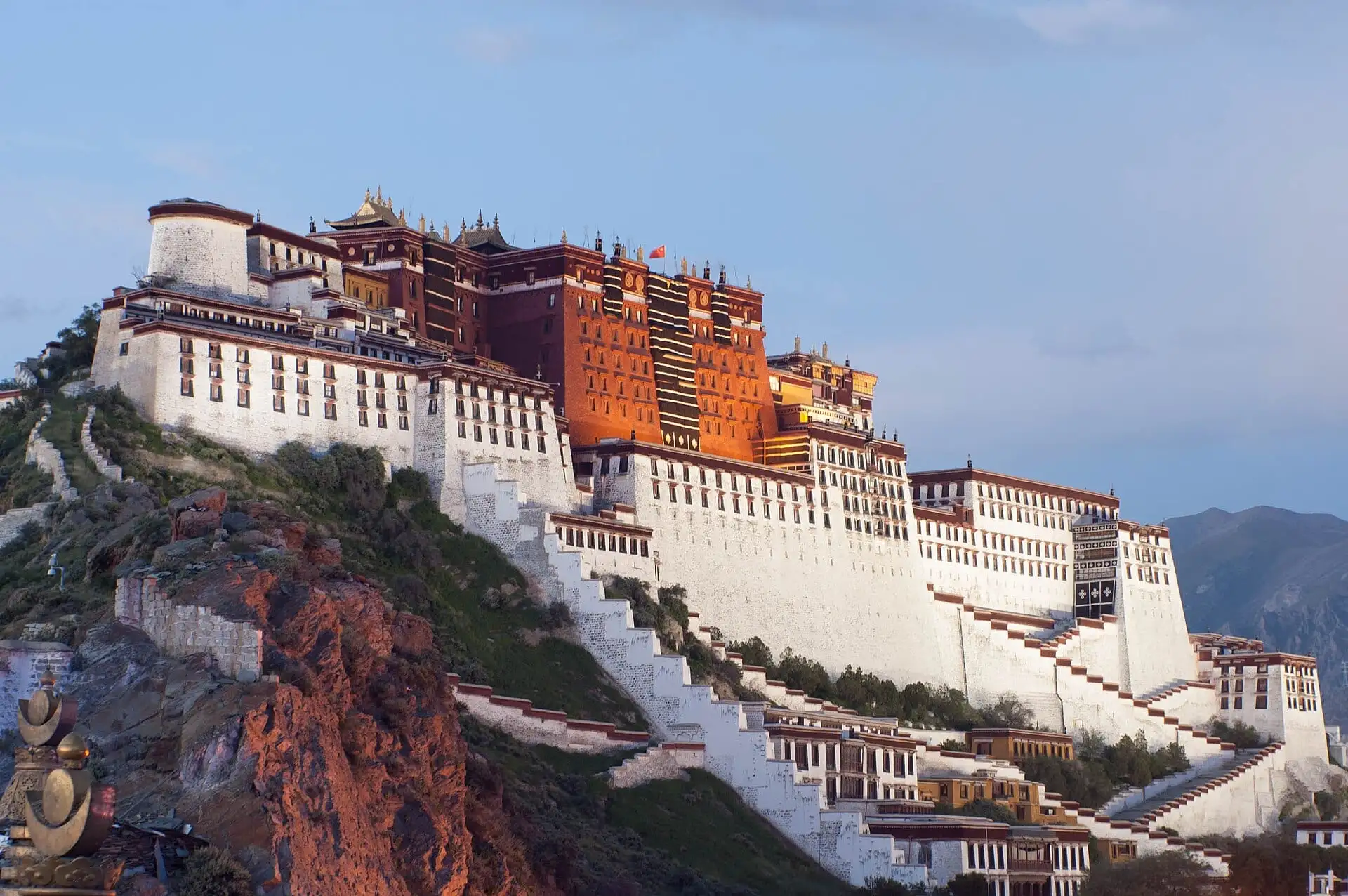
The Potala Palace
- Tickets: about ¥200 from May to October, ¥100 from November to April. Your agency books them, with your passport. Entry has been free during Tibet’s winter tourism campaign (15 October 2026 to 15 March 2027 this year). More in Potala Palace tickets.
- Daily limits: tickets go on sale 7 days ahead and sell out in summer. There are no tickets on the day.
- Closed on Mondays (since 21 September 2026, after opening daily over the summer), except on public holidays. Plan at least two days in Lhasa, so a Monday doesn’t cost you the visit.
- One hour inside. Visits are timed. No photos in the halls and chapels, and no water bottles or lighters.
When to go
- April to early June and September to October: the best weather and clearest views.
- Mid-June to August: the busiest and most expensive, with more rain.
- November to March: cold, but clear, quiet and the cheapest time to go. Lhasa is still very pleasant during the day.
See also the best time to visit China. Alipay and WeChat Pay work in Tibet as elsewhere: set them up before you go, as explained in paying in China.
Our pick
For a first visit, 4–5 days in Lhasa, or 8 days to Everest Base Camp if you can spare the time. Book in April–May or September–October, send your documents at least 20 days ahead, and fly in from Chengdu. Rules here change with little notice, so confirm the details with your agency before you book flights.